Welcome to the World of Box Cameras


“My box Brownie was a trusted companion for years and has given me more pleasure than I could ever imagine possible. Family gatherings, holiday outings or a visit to dad’s old farm were just the occasion to get my sturdy little friend out of its closet. It was an incredibly simple camera with no dials and knobs to fuss about. My husband chose to steer clear of me : he worked with an expensive folding camera and used an exposure meter as a crutch all along. So while hubby was busy measuring the light and distance I would wipe my lens clean with a handkerchief, back up the ten feet from the group, put the sun at my back, peep into the tiny view-glass at the top and snap away happily. . .”

--Maria Ward

Maria’s words bring back the long forgotten romance of box camera photography in the first half of the twentieth century. Imagine the thrill of buying a roll of film, loading your box and moving out into the wooded landscape on a sunny day. On your way back late in the afternoon, you drop the film at the nearest photo lab, or if you are adept at handling chemicals, head straight for a session in the kitchen-turned-darkroom. Whichever the method, you are working along the same lines as did hundreds of others in the early days. And the reward of your labors comes on the following day when family and friends crowd around you letting out squeals of delight, each of them eagerly passing around the snaps, and  junior enormously pleased to see himself standing beside the car with a sombre expression on his face.


Although a precision instrument made with the same care and thoroughness bestowed on its more sophisticated rivals, the key feature that distinguishes a box camera is its simplicity. Hundreds of these gadgets were in production earlier using a variety of film sizes. Thousands were stocked by photographic dealers to be eagerly snapped up by people who wanted to take family get-togethers back in the home or out on a picnic, and who were just a bit scared of the intricacies of a gadgety professional camera. Turn over the leaves of an old album and you will find evidence in the form of those golden-brown snapshots showing granny when she was a girl, or granddad trying to push hard against the lawn mower. And how charming these pictures look!


First Lessons


The reader who is coming to the subject of photography for the first time may find himself bewildered by the terminology used by the camera dealer down the street : the stops, shutter speeds, film development and the like. If you are planning to buy a box camera and are feeling confused and hopelessly at sea, this article should help dispel most of your doubts.

The simplest kind of camera is a pin-hole camera. As the cut-out illustration here shows, this is a light tight box with a tiny pin prick made on one side and a sheet of film held at the other side. If the box is now aimed at an object, rays of light coming from the scene criss-cross each other as they pass through the pin-hole giving rise to a faint upside down  image on the film.


A pinhole camera forms an inverted picture of a scene, and forms
the basis of the camera-obscura, the forerunner of the
modern camera.

The pin-hole camera is often looked upon as a mere scientific novelty, but actual photographs may be taken with the device, the only impediment being that as the image produced is exceedingly dim in illumination, the film or plate has to be exposed for a lengthy period running into several minutes.

A pin-hole device can also be used as an object of amusement. For this purpose, the back of the box which receives the film is replaced by a sheet of tracing paper or a ground glass screen. If the box is now pointed at a brightly lit scene and the user takes cover under a dark cloth or blanket, he will find a faint image appears on the screen. If the picture is too faint to be viewed comfortably the pin-hole may be enlarged. This gives a brighter result but increases the fuzziness of the picture. For best results, a simple positive lens from the optician’s shop held in a cylindrical cardboard tube may be substituted in place of the pin-hole. With a bit of trial the lens can be focused when a bright and clear picture will be seen on the screen. A device of this kind is known as a camera obscura, and was used in the 17th and 18th centuries by artists to trace perspective views of landscapes and architecture in paintings.

The camera obscura with its bright, magical image was also used as a novelty in public places in earlier times. People marvelled at the lifelike picture showing branches swaying in the wind, people moving around, and architecture, but the picture seen was only a fleeting impression leaving no permanent trace on the wall or screen which received the impression.

The camera obscura embodies within it the basic principle of the photographic camera, but the arrival of photography had to wait till the mid-nineteenth century when advances in applied chemistry made it possible to record the image permanently on a chemically treated surface.

Photography is thus the result of two distinct lines of scientific progress : optics, which helps form an image of a scene on a flat surface, and chemistry, which produces a permanent record of this image.

In 1851, a London sculptor named Scott Archer came up with a chemical process of photography known as the Wet Plate Process, which though far too cumbersome by present day standards, was nonetheless a great improvement on earlier processes in use (read more about this later). Archer's process remained in use until 1871, when Richard Leach Maddox came up with the idea of dry plates. A dry plate was a glass plate with a photographic light sensitive coating quite similar to the one we have on photo-film today, and the process, unlike Archer's method, made it possible to take camera exposures whilst the plates were dry. This innovation was to set an important milestone; it marked the beginning of modern photography, paving the way for further improvements in the line. It also led to the invention of flexible photographic  film as we know it today. Once the basic problems of the process were overcome inventors and designers turned their attention to devising all kinds of innovative features aimed at making the camera a versatile tool. In the early days of dry plates, a great number of detective spy cameras appeared, each tiny instrument promising a feature that made it remarkably easy to take pictures outdoors without drawing attention to itself. Among the camera models developed from the last decade of the nineteenth century onwards were the hand-held folding camera using accordion style bellows designed so that the camera could be made to collapse ; the twin-lens reflex and the single-lens reflex ; and the miniature, a camera so unobtrusive it made possible for the first time true candid shots of everyday scenes. Each of these designs was highly sophisticated and gave splendid performance in the field for which it was intended, but the knobs and dials on these instruments also meant that amateurs generally tended to look upon photography as an impossibly difficult pastime requiring specialized knowledge. The box camera, first introduced by George Eastman in 1888, overcame this difficulty by presenting the amateur with an instrument simple enough to operate and having the minimum of adjustments, thus bringing photography within the scope of the average layman who had no knowledge of the subject.

With this background information in hand, we are in a position now to take a closer look at the inside of a box camera. No matter how complicated it may seem, every film camera is made up of a light tight box with a lens at one end whose purpose is to project a clear, well-defined image of the scene being photographed onto a light sensitive film held flat at the other end.

The figure here shows a simplified view of the interior of a box-type camera. These cameras typically used ‘roll film’, available earlier in a variety of sizes. As you can see, the loaded spool is held at the bottom of the box and after each picture is snapped a film wind knob or key is turned to bring fresh unexposed film over the picture area in readiness for the next picture.


The interior of a box camera. Note that the film carrier which
holds the spools is omitted. 

Many box cameras employ a simple meniscus (or spectacle type) lens to form the picture on the film. Working on its own, a simple lens of this kind gives a fuzzy image, and the manufacturer gets round this trouble by having a thin metal plate next to the lens with a tiny hole punched in it. This plate, known as a ‘stop’ blocks off all extraneous light rays coming from the subject letting only a narrow central beam to get across resulting in a picture that is sharp and well defined over its whole area.

Working close to the stop is another mechanical contrivance that is known as the shutter. In a box camera the shutter may consist of a spring-driven plate which in its normal state covers the lens opening in the stop thereby allowing no light to reach the film. When you press the button to snap a picture, the shutter blade smartly flips aside flashing the picture on the film briefly (usually 1/25 second) before it moves back into place to cover the lens opening again.

The shutter therefore decides the duration of time light acts on the film when you take the picture. The stop on the other hand governs the brightness of the image momentarily flashed on the film—the tinier the lens opening, the fainter the picture flashed. Between them, these two components govern the total quantity of light reaching your film during picture taking.

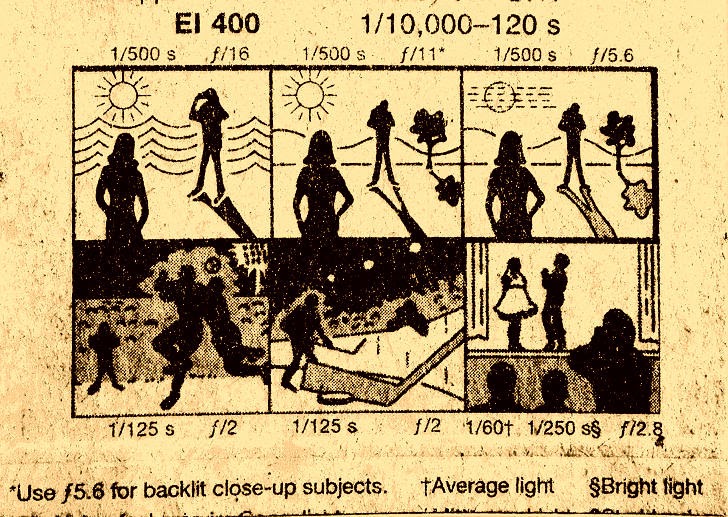
Film instruction sheets carried exposure tables to
guide the novice. This exposure chart was supplied with
a film having a speed of 400 ASA. As such films are generally
used for low-light work, the chart lists both indoor and
outdoor subjects.
If you pick up a professional camera like a single lens reflex, you will find that it carries a number of dials and levers with numbers printed alongside. These cameras being sophisticated are provided with expensive lenses with a stop whose opening can be varied within wide limits, and likewise the shutter is an intricate mechanism giving a range of exposure times. The beginner when asked to take a picture with such a camera may find it requires a good deal of mental gymnastics to select the lens opening and shutter time that will lead to a successful picture. He will find that he is better off with a box camera which requires very little thinking on his part. The camera manufacturer is aware of this difficulty and he simplifies his box by having a single lens opening and a fixed exposure time, so chosen that a picture taken outdoors in bright sunshine comes out with perfect success. A box camera is therefore a fair weather camera, although several models were made with 2, even 3 different lens openings which allowed pictures to be taken outdoors even when it was dull and cloudy.

But to return to our illustration, the lens shown here is set in the body of the camera with no adjustment for focussing. This may appear strange, but it is yet another way the designer simplifies the operation of his camera. A lens of this kind is known as a fixed focus lens ; it is set during manufacture to give sharp pictures of distant objects. As the stop opening used on these cameras is only the tiniest hole about a few millimeters wide, objects even as close as 7 or 8 feet away from the camera begin to pose as ‘distant’ for the lens. This means that everything about 8 feet away and beyond will appear with equal sharpness on the film, a feature welcomed by most amateurs as it frees them from the worry of focussing while snapping their pictures.

Having now seen the interior of a box camera, let us now suppose we actually load our box with a film and try our hand at taking a few pictures outdoors. Roll films, as your photo dealer will show you, come in a variety of ‘speeds’. The speed of a film is  measure of its sensitivity to light. Thus a film with ISO 50 marked on the box  has low sensitivity and is said to be a slow speed film. A speed of ISO 100 or thereabouts is considered a medium speed film and is recommended for general photography. On the other hand if the film box is marked ISO 400 or so, it means it is a high speed film requiring only a very short burst of light to register the image.

For most general photography, a medium speed film is all that is needed, so we load up our box with a roll of medium speed.  Now as we go about snapping pictures, what actually happens within the camera is this : each time you click a picture, the lens projects on the film an image of the scene in a short burst of light. Although no picture appears at this stage, a chemical change has in fact occurred on the emulsion, which is the light-sensitive coating on your film. An invisible picture known as a latent image has been formed on the emulsion. Next, the film is removed from the camera in total darkness and put through a solution known as the developer which brings out the image. This is followed by another solution known as a fixing bath which makes the picture a permanent record and keeps it from fading away in time.

After the film has been washed and dried it may be inspected by holding it up to the light. The picture will be now clearly seen. It is a darkish record ; light areas in the original scene appear dark, while dark areas are rendered white. The image formed is thus reversed in tones and is known as a negative. 

Having secured a record of the scene as a negative, the next step consists of laying the negative on a photographic paper and shining a light onto it. When the paper is processed in chemicals similar to those used in making the negative, a picture in life-like tones is produced.

This is only the beginning of our excursion of this fascinating subject. As you go along, you will find more examples of work produced with a box camera. You will also find interesting historical details as well as a full technical discussion of the features of these cameras further on in this website.

Ravindra Bhalerao


What the Experts Have to Say....


A friend who worked with an expensive single lens reflex once asked me what was so special about a box camera that made me perennially harp on the same subject with such ardour and enthusiasm. I do work with an SLR when the need arises, but at the time I could think up of no answer to this question; I was baffled. I merely grinned at my friend and mumbled that I was fascinated by the old box, that it was simple to work with and cute to look at...

I think the appeal of the box camera can be traced to the following two reasons : first, it is grand old vintage stuff ; and secondly, being devoid of mechanical and optical sophistication, it resembles in some measure an optical toy. I know of photographic collectors who spend days hunting for an old revolving zoetrope, a magic lantern, even an early hand-cranked cinematograph. The box camera can be likened to one of these optical toys. But it is more than a mere toy--it is simple in construction, and yet it works. And I would say it works rather well.

The fascination we feel for a box may be likened to what pin-hole camera enthusiasts feel. There is nothing as lovely as a pin-hole camera. It gives an image that is mathematically an exact perspective view of the subject, it involves little more than a shoe box pricked on one side with a microscopic hole, and ignoring the long exposures called for, it gives reasonably good results, so that when holding up a pin-hole print one can only wonder with delight how a simple device as this is capable of giving a picture without the accompaniment of a lens.

I was wondering all along who invented that ingenious little red window you see at the back of a box camera to show up numbers printed on the backing paper. The mystery was cleared up a few years ago when I came upon an old book on photography in a second-hand book store. It wasn’t George Eastman who came up with this innovation, as I had thought. The red window dates back to 1892, I found, when Samuel Turner of the Boston Camera Company designed a box camera called the Bull’s Eye, the first ever camera to use film rolled in black paper with a red window at the back of the camera. 

Books on photography are as old as photography itself and it can be a real pleasure browsing through some of the early works. Here is a selection of comments made by notable photographic authors of yesteryear telling us about what a box camera is like and what it can be expected to do :
--------------------------------------

“The Kodak camera created an entirely new market and made photographers of people who had no special knowledge of the subject and who had as their only qualification the desire to take pictures.”

From ‘George Eastman’, a Kodak publication.
--------------------------------------

The Camera that takes the World !

   THE  KODAK   
No previous knowledge of photography necessary.

  “YOU PRESS THE BUTTON, WE DO THE REST,”  

(Unless you prefer to do the rest yourself)

  AND THE PICTURE IS FINISHED.  

From an 1893 advertisement for the Kodak camera.
--------------------------------------

“...Your box camera is a valuable friend. It provides the best method of recording for all time such happy occasions as the joys of holiday-time, weddings, the first baby, and all the landmarks in family life. It is also an important tool in one of the best hobbies imaginable—Photography...  Simple in design though it may be, your box camera can perform wonders if used correctly...”

Your Guide to Better Box Camera Photography, Fountain Press, 1950.
--------------------------------------

“A box-type camera of today may not look at all like the boxes of yesteryear, but functionally it is quite similar. Its most significant characteristics are that the size of its lens opening and the duration of its shutter time are fixed in manufacture. They are usually set so that on a bright sunny day they will deliver just the correct amount of light for those films which are recommended for box-type camera use...  Deluxe models (also) offer a limited choice of different lens openings.”

The Kodak Camera Guide, Pocket Books Inc, New York, 1959.
--------------------------------------

“....There is nothing simpler than a box camera. It produces a sharp, precise picture, so careful focusing is made unnecessary. But this advantage can also become a disadvantage, since both foreground and background are clearly defined, and in consequence important and unimportant objects are equally portrayed. A further convenience and yet limitation of this camera is the simplicity of its shutter speeds. Therefore you cannot adapt the exposure time to the movements of the subject you are about to photograph...”

   Everybody’s Guide to Good Photography—The All-in-One Camera Book by W. D. Emanuel and F. L. Dash, Focal Press, 1944.

--------------------------------------

“...The box camera is the simplest and cheapest type of camera. It is mainly intended for people who want to take snapshots in good light and who do not know—or want to know—a lot about photography....  In spite of its simplicity the box is capable of taking photographs of a high standard...”

The Focal Encyclopaedia of Photography, Vol. I, Focal Press, London and New York, 1965.
---------------------------------------

“...Because they are so easy to use, Brownie (box) cameras are excellent for beginners. They are mainly intended for snapshots in sunny weather, but most models have a time exposure adjustment so that they can take pictures in dull weather as well...”

How to Make Good Pictures, Kodak Limited, 1951.


Memories in Black and White


By Radha Nair 
Freelance Writer, Pune


WHEN I WAS IN SCHOOL, THERE was only one girl in my class who owned a box camera. So when she brought it along for the school picnics, she was the centre of great adulation. Everyone wanted to get as close to her as possible, just to see how this magic box worked.

We hung round, while Tina Vakil gently eased out her Kodak box camera from its leather case. We watched her  in focused silence, as she slowly made precise adjustments with the camera. Then she chose a scenic spot and got us all to stand together, as tightly as possible, while she framed us on the viewfinder before she took snaps of us at the Borivili National Park.

We looked on with speechless delight when days later, we were each presented with a copy of her master shot. It was a historic moment. This was in Std. X.

Then there was the class photograph taken at the end of the term each year.  I remember the photographer would come to my school with a cumbersome camera, which he set up in laboured stages on a wooden tripod. The brontosaurus would be veiled in a mysterious black cloth. Close to him would stand his assistant, holding a protective umbrella over his head. 

We were clubbed together thus, the prettier and fair ones sat close to the stern class teacher, while the shorter ones were given the edges of the front row. Thus many best friends were separated and it showed up sometimes in the glum expressions in the final photograph. The taller ones stood in the third and fourth rows and struck up poses straight out of the latest MGM flick.

Meanwhile as we waited, straightening out our box pleats, Crystal Rose De Souza and Jennifer Godfrey held their heads of recently permed hair  extra high, triggering off some silly, whispered remark. This made us all giggle helplessly. The photographer already discomfited, under the unwavering gaze of 35 mischievous girls, mopped his brow in exasperation.

The 3 o'clock sun would beat down on us mercilessly, while the photographer took his own sweet  time making all kinds of adjustments, and would call out Ready a couple of times, and say Smile, and we smiled and smiled, only to find out the photographer was not ready, for in the last minute  he would discover he had forgotten to attach some vital connection which he fished out of his pouch in slow motion.   

He would repeat the same drill, and suddenly when we least expected it, the flashgun would explode in our faces. Nine times out of ten, we would be caught blinking foolishly in its blinding light. He would then pull of a cap off from the lens, and dramatically cap it again.

These photographers of yore, with their quirky mannerisms were really unforgettable characters.

In my native Kerala too, family get togethers were special, not for the lunch, nor the gossip that swirled around, but the family photo which was going to be taken post lunch.

Carved chairs would be placed in a row in the forecourt of our ancestral mansion, against the lush background of coconut and mango trees.

The patriarch would sit stiffly in his crisp, newly ironed mundu (dhoti)and jubba (collarless, knee length shirt), with its descending  row of tiny gold buttons, flanked by the well endowed matriarch, who  occupied  her seat as well as  half of his. 

Then came the other grand aunts and uncles who were seated according to the family pecking order.

At their feet, massed in fidgety confusion sat all those under ten. The rows behind were taken up by the younger generation, mostly newly weds, clinging romantically together in the afterglow of newly wedded bliss. 

The last row was all male, the college going crowd, which looked superciliously down at all the rest, fully aware of being the first generation that had made it beyond the fourth form!

All of us used to stand stiffly while the photographer called out, “Tilt your head this way. No that way,  Move a little closer, STEADY  arrange an elbow this way,  STEADY, Hoist a  shoulder that way. Chin up there STEADY—NO,  NO,  chin down, STEADY. . .” His confusing instructions would finally end up in all of us looking like dying ducks in the final  shot.

Photography had come into the lives of my grandparents and their siblings, somewhere in the misty turn of the nineteenth century, when painted portraits were slowly phased out in favour of photographs.

So,  exquisite oil paintings - - -  which brought out the regal beauty of grand aunts in their diaphanous white muslins  - - - - - the  ultimate  foil for their honey gold complexions;  and who were decked out royally  in the traditional chunky  gold necklaces, earrings and bangles which Malabar jewelry was once famous for, - - - - were slowly taken down from the walls.

Up came instead,  black and white photographs oval framed, of grand uncles in unfamiliar white coat and trousers seated in imperious semicircles, legs crossed elegantly after the British fashion, their chins  jutting out  a tad too defiantly, glazed expressions challenging the onlooker.

In the grandest room in my ancestral home, pride of place was given to a huge photograph which occupied much of a single wall. It was of a football crazy uncle who proudly chested, hundreds of silver medals won at many a paddy field tournament. Alongside, his brother who had then joined the army, sat in starched khaki shorts and shirted splendor, with an impressive cross leather belt on his chest adding further aggression to his unsmiling countenance.

Aunts in the first bloom of youth posed bashfully, strung together tightly like the flowers in a garland, their arms hanging down in terrified stiffness. Their meek expressions reflected the way they had been brought up. In their tender years they were taught never to smile in the company of strangers . . .  and they never did!

Then there were angled photographs of aunts, who had just joined Queen Mary’s college in Madras. All of them stared at the same distant point, affectation obvious in the way  their right  arms identically angled at the  waist clutched their left elbows in self conscious rigidity.  

Wedding photographs of my uncles and their spouses, spoke of uncertain beginnings. The couple stared unwaveringly into a glorious future. The uncles were booted and suited,  their  hair slicked back with Brilliantine, their wives wore  pure white, gold bordered  saris, their hair elaborately coiffed after the style of the reigning film actresses, with a string of flowers on their buns.

Home made kohl which was lavishly applied, sadly seemed to streak their otherwise sweet faces, pooling darkly under their eyes. You could sense their discomfort, after their punishing hour with a disgruntled photographer.

Next, hung up in single file, were photographs of each of their first born. Each one bore the trademark black spot on the right cheek to ward off the evil eye.

The front row in the naval photographs from the days when my father served the navy, blazed him and his colleagues, seated in sparkling white uniforms, their crested caps resting on one knee while a clenched fist rested on the other. The way the hands and feet were placed breathed a military precision.

Those standing in the rear, posed an affected shoulder angle, working inwards from the edges towards the centre, their elbows crooking their naval caps.

Albums of school photographs showed up the innocence of those days, so obvious in the open smiles. The dreams we had, are still there in those photographs, in our starry, starry eyes, blithe unconcern  in our languid stance, for we had not known then, what fear or rejection  was.

Those black and white photographs have been the strongest anchor in my life.

Looking at these photographs for me is time well spent, for it is a soothing return to an age which had known much peace and contentment.